

How to Choose Best Companies That Install Concrete Pickleball Courts
You’ve likely felt the addictive energy of a rally at your local court and started thinking about bringing that same experience home. But building a high-performance playing surface isn’t as simple as pouring a patio. Choosing among the best companies that install concrete pickleball courts is critical—because the wrong contractor can leave you with cracks, drainage issues, and inconsistent ball bounce.
A professional pickleball court requires engineering precision, material expertise, and adherence to strict standards such as those outlined by USA Pickleball. From slab tolerances to surface coatings, every detail affects playability, safety, and long-term durability. That’s why working with experienced specialists like Ace Coatings Sacramento ensures your court is built to perform—not just look good.
Best Companies That Install Concrete Pickleball Courts: What Sets Them Apart
Not all contractors are equipped to build a true pickleball court. The difference between a general concrete crew and a specialized court builder lies in precision, materials, and long-term performance.
Professional installers focus on:
Surface tolerance (within 1/8 inch over 10 feet)
Proper drainage slope (0.8%–1%)
High-strength concrete (minimum 4,000 PSI)
Sport-specific acrylic coatings
Companies like Ace Coatings Sacramento bring specialized expertise in both structural concrete and sports surfacing systems. Their approach ensures that your court performs consistently for years—not just months.
Additionally, top-tier contractors often provide warranties ranging from 10 to 20 years, reflecting confidence in both materials and workmanship.
Why the Best Companies That Install Concrete Pickleball Courts Use Post-Tensioned Concrete
One of the biggest upgrades in modern court construction is post-tensioned (PT) concrete. Unlike traditional slabs, PT systems actively resist cracking by applying internal compression.
Here’s how it works:
Steel cables (tendons) are placed within the slab
Concrete is poured over the system
After curing, cables are tensioned to ~33,000 lbs
The slab is compressed, increasing durability
This method is especially valuable in areas with soil movement or temperature fluctuations. Ace Coatings Sacramento often recommends this system for homeowners who want maximum longevity and minimal maintenance.
Think of it as an “insurance policy” for your court—higher upfront cost, but significantly fewer repairs over time.
Concrete Pickleball Court Installation Cost and Key Factors
Understanding cost helps you make smarter decisions when planning your project. While pricing varies, several core factors determine your total investment:
Site preparation and grading
Concrete thickness and reinforcement
Drainage systems
Acrylic surfacing layers
Add-ons (fencing, lighting, nets)
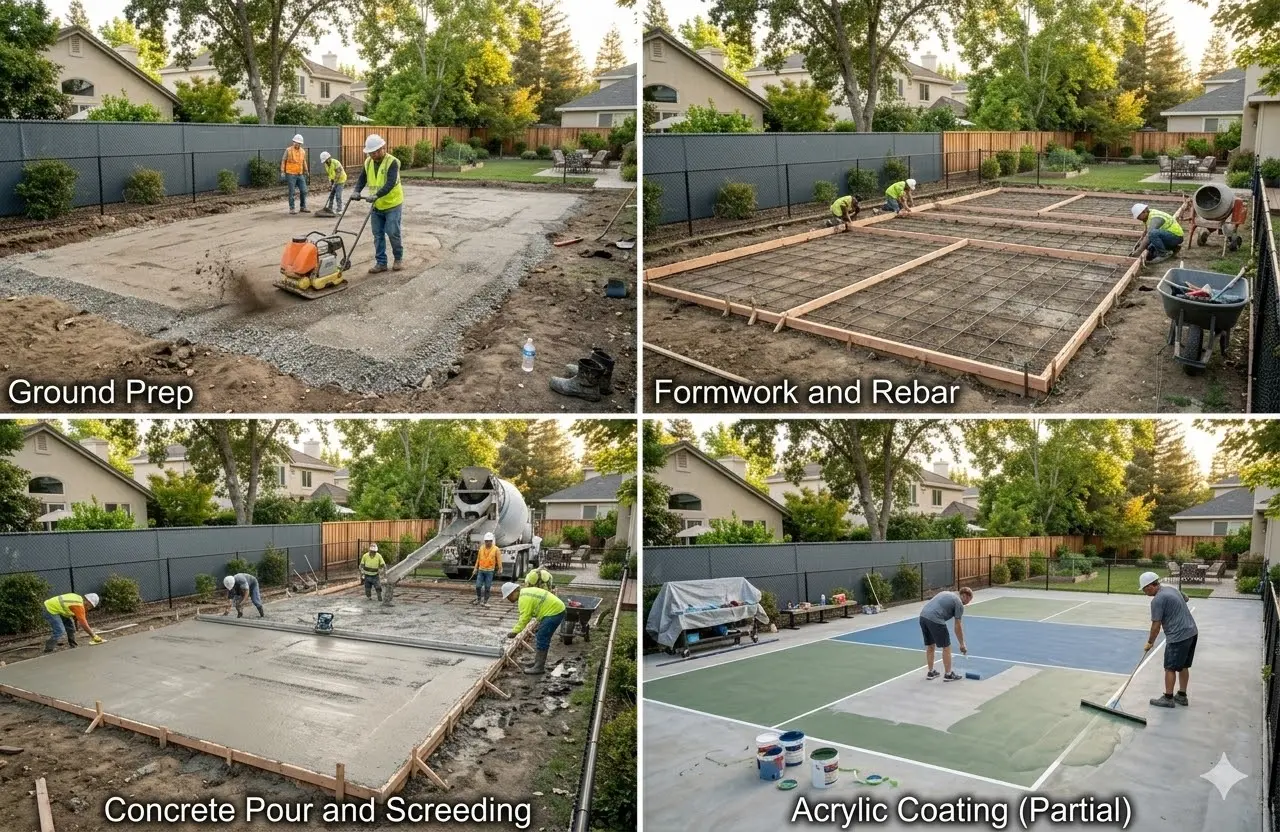
A standard residential court typically uses a 4-inch slab, which balances cost and durability. For heavier-use courts, a 6-inch slab may be recommended.
How Thickness Impacts Cost and Performance
Concrete thickness plays a major role in both longevity and playability.
4-inch slab: Ideal for residential use
6-inch slab: Best for public or high-traffic courts
But thickness alone isn’t enough. Proper sub-base preparation and vapor barriers are essential to prevent moisture damage and surface failure.
Ace Coatings Sacramento emphasizes full-system construction—ensuring that every layer, from soil to surface, works together seamlessly.
Acrylic Surfacing Systems for Professional Pickleball Courts
Once the concrete base is complete, the surface coating defines how the court plays. Acrylic systems are specifically engineered for pickleball, offering grip, durability, and consistent ball response.
These systems include:
Multiple acrylic layers
Silica sand for texture
Optional cushioned underlayers
The texture is often described as a balance between “sandpaper and silk”—providing traction without slowing the ball too much.
Choosing the Right Texture for Performance and Comfort
Surface texture directly affects gameplay and player comfort.
Standard acrylic: Faster play, firm surface
Cushioned systems: Reduced joint impact, longer play sessions
For homeowners planning frequent use, cushioned systems can significantly improve comfort without sacrificing performance.
Professionals like Ace Coatings Sacramento help tailor the surface to your specific needs—whether recreational or competitive.
Why Drainage and Site Preparation Matter More Than You Think
Even the best surface will fail without proper drainage. Water pooling leads to peeling, cracking, and costly repairs.
Professional installation includes:
Laser-guided grading
Compacted sub-base layers
Drainage systems and slope control
A simple test used by experts: placing a 10-foot straightedge on the surface. If a coin can fit underneath, that spot could become a future puddle.
This level of precision is what separates average contractors from the best in the industry.
From Planning to Play: Choosing the Right Contractor
Before starting your project, make sure your contractor checks all the right boxes:
Experience with sports court construction
Knowledge of local permits and zoning
Proper insurance coverage
Proven portfolio of past projects
Long-term warranties
Working with a trusted provider like Ace Coatings Sacramento ensures your project is handled professionally from start to finish—from permits to your first game.
Take the First Step Toward Your Dream Court
Building a pickleball court is more than a home upgrade—it’s an investment in recreation, health, and long-term value. By choosing experienced professionals and understanding the construction process, you can avoid costly mistakes and enjoy a court that performs for decades.
If you’re ready to get started, now is the perfect time to plan your project, define your space, and request expert guidance.
Contact us at Ace Coatings Sacramento today to schedule your consultation and bring your custom pickleball court to life.
